Managing External Distractions: When Your Kid Puts Up a “Do Not Disturb” Sign Clearly Aimed at You
Larry shares a light-hearted, real story of when he unintentionally became a distraction to his daughter, who was trying to be productive. He uses this story to provide guidance on how we can manage our external distractions.
Larry Worth
12/8/20255 min read
During lockdown in 2020, our kitchen turned into one of those open-concept coworking spaces.
Except the “coworkers” were my wife, my daughters, our dog, and me.
And the only person who wanted quiet was the one trying to pass ninth grade on Zoom.
At the time, our oldest was still undiagnosed. She did what a lot of kids did during that wild year. She started out in her bedroom, camera angled just right, living on Zoom. After a couple of weeks, she announced that being in her room all day was making her miserable.
So, she claimed the kitchen table.
As a parent, this felt amazing.
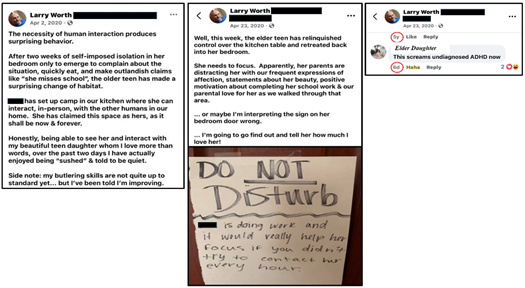
She was out of her room. I could see her, talk to her, experience her teenage presence in the wild. I even wrote a Facebook post bragging that she had “set up camp in our kitchen” and that I loved seeing her every day.
Then reality set in.
Because as it turns out, there is a big difference between “I can see my kid any time I want” and “my kid can get anything done while her father provides running commentary.”
I was that commentary.
“Hey, beautiful, want a snack, lunch, anything?”
“How is class going?”
“What are you working on?”
“You hungry?”
“You doing okay?”
“Want me to heat up something?”
“Need help with that assignment?”
Apparently, she only needed help with one thing.
Me.
A couple of weeks later, I posted an update. The kitchen era was over. She had surrendered the table and retreated back into her bedroom.
As I wrote at the time, her parents had become the distraction. The evidence was taped to her bedroom door.
Big bold letters: “DO NOT DISTURB.”
Underneath, in smaller teenage handwriting,
“I am doing work and it would really help me focus if you did not try to talk to me every hour.”
This was clearly aimed directly at me. I had become the human version of a pop-up ad.
Five years later, that old Facebook memory popped up, as they do. My now diagnosed, now fully self-aware ADHD daughter in her junior year in college and on Facebook commented on it:
“This screams undiagnosed ADHD now.”
This was a very true statement she was making about herself while showing good humor about the situation years ago.
But here is what it really showed.
Her environment changed.
Her distraction level changed.
Her brain did not.
The kitchen felt better emotionally, but worse cognitively. The bedroom felt lonely, but it allowed her to regulate her attention. She did not suddenly become “more disciplined.” She just got some distance from her biggest external distractions.
Her parents…and by parents, I absolutely mean me.
So, what do we do with that little case study in accidental productivity sabotage?
This is where we need to talk about external distractions and ADHD.
External Distractions Are Not Just Noise
When people think about distractions, they picture loud sounds, constant notifications, or the dog barking every three minutes.
Yes, those are all distractions. But for ADHD brains, many external distractions are often emotional and relational.
The people you love most can be the biggest attention magnets in the room.
Kids, partner, roommates, coworkers, pets, the group chat, all of it pulls on the same limited pool of attention and dopamine your brain is trying to use for that assignment or work project.
When my daughter moved to the kitchen, she traded one kind of discomfort for another.
Bedroom: less stimulation, more boredom, more internal distraction.
Kitchen: more stimulation, more conversation, more “Dad, please.”
Both spaces had friction. One friction was inside her head. The other was standing in front of the fridge asking if she wanted a sandwich.
Neither of those are “discipline problems.” They are design problems.
The ADHD Brain and Environmental Design
ADHD brains are driven by stimulation. The brain wants novelty, movement, conversation, and quick hits of reward. That is why your brain perks up when someone walks into the room, or when your phone lights up, or when a family member opens a bag of chips within a fifty-foot radius.
Your attention will always drift toward the thing that feels more interesting, more urgent, or more emotionally loaded.
If your environment constantly feeds you that stimulation, you are going to struggle to focus, even if you care deeply about what you are working on.
That was my daughter in the kitchen.
Parents and pets walking through
A dad who thought he was being supportive
The temptation to join whatever conversation was happening
Her brain did exactly what ADHD brains do. It followed the stimulation.
So, she did something brilliant. She built a boundary with construction paper and some tape.
“Do Not Disturb. I need fewer distractions.”
That door sign was her first productivity system.
What We Learned About Managing External Distractions
If you saw yourself or your kid in that story, here are a few practical takeaways.
1. Your Workspace Needs Rules, Not Just Furniture
A desk in the middle of family life is not a workspace. It is a magnet for interruptions.
Decide what the rules are for that space.
When the headphones are on, assume “do not disturb.”
When the door is closed, knock and wait.
During certain time blocks, questions and “quick chats” can wait.
The sign on the door is less about being dramatic and more about giving everyone a clear signal.
ADHD brains love clear signals.
2. People Are Distractions, Even When They Love You
This one stings a little as a parent. Affection, curiosity, and frequent check-ins feel caring. From the receiver’s side, they feel like attention theft.
If someone in your office (or house) is trying to focus, assume you are a potential distraction just by being there.
A good question to ask yourself:
“Does this interruption help them right now or help me feel connected right now?”
If the answer is mostly about you, save it for later.
3. Schedule Connection on Purpose
One reason we interrupt each other so much at home and work is that we do not have reliable connection points.
So, every moment feels like “If I do not say it right now, I will forget.”
Create small anchors during the day.
A quick check-in before focus time starts
A ten minute “social break” between classes or meetings
A recap at the end of the day
When you know connection is coming, it is easier to hold the boundary in the middle.
4. Make Distraction Management a Team Sport
The most productive thing we did after the “Do Not Disturb Dad” incident was talk about it together.
What makes it hard for her to work when we are around.
What we are allowed to interrupt her for.
What she needs from us to stay regulated.
You can do this at home or with coworkers.
Ask:
What interrupts you the most?
How will we signal “I am heads down right now”?
What are the emergencies where interrupting is still okay?
ADHD brains carry a lot of shame about distraction. Turning it into a shared problem instead of a character flaw takes the temperature down for everyone.
Bringing it Back to that Door Sign
When I look at that old picture now, it makes me smile because I see more than a teenage boundary.
I see a kid who knew her brain needed fewer inputs.
I see a dad who needed to realize that “being available” is different from “being present every second.”
I see early evidence of ADHD patterns that we did not have language for yet.
Five years later, we have the language. She has an ADHD diagnosis. I wrote a book about ADHD productivity.
She's now in college, and we still talk often. I don't take it personally when she sends me a reply text that we will talk later because she is in the middle of coursework, her job, or a social event. That's her modern-day note on the door. Message received.
If you are struggling with external distractions, ask yourself:
Is my environment giving my brain a chance to focus
Who or what keeps pulling my attention away
What is my version of that “Do Not Disturb” sign
You may not be able to control your entire world, but you can tweak your little corner of it.
And if someone in your life puts up a sign that basically says, “Please stop talking to me every hour,” try not to take it personally.
They might just be doing the most ADHD friendly productivity move of their life.
You can be a welcome distraction for them later.
Connect
Questions, thoughts, or just saying hi!
support@tryingharderwontwork.com
© 2026. All rights reserved.